
When MMW Challenges Push the Limits of Design, We Reengineer What’s Possible
Micro Harmonics was founded on the clear belief that advancement at millimeter wave (MMW) and terahertz (THz) frequencies requires components designed to resolve industry challenges. We are committed to listening to our customers, learning about their needs, and designing innovative solutions.
The pace of innovation in radio astronomy, quantum computing, and high-frequency test systems continues to climb, and engineers routinely face constraints that don’t appear when working at lower frequencies.
As engineers move into the MMW and THz regime, off-the-shelf hardware often can’t keep up.
The stories below show how specific requests from researchers and system designers pushed our team to rethink form factors, tackle unusual waveguide bands, and extend ferrite technology deeper into cryogenic territory.
Making Cryogenic Isolators Even Smaller for Radio Astronomy
Cryogenic RF chains used in radio astronomy rarely have the luxury of excess volume. One customer working on a multi-element array needed to place several WR-10 cryogenic isolators directly side-by-side, which meant the standard flange width simply wouldn’t fit.
The issue wasn’t performance; it was geometry. A normal WR-10 waveguide flange includes four screws. That footprint becomes a problem when dozens of identical channels must be densely packed. The solution was to reconfigure the mechanical interface. By removing two of the four flange screws and redesigning the housing accordingly, the isolator could be narrowed enough to meet the array spacing without compromising alignment or thermal behavior.
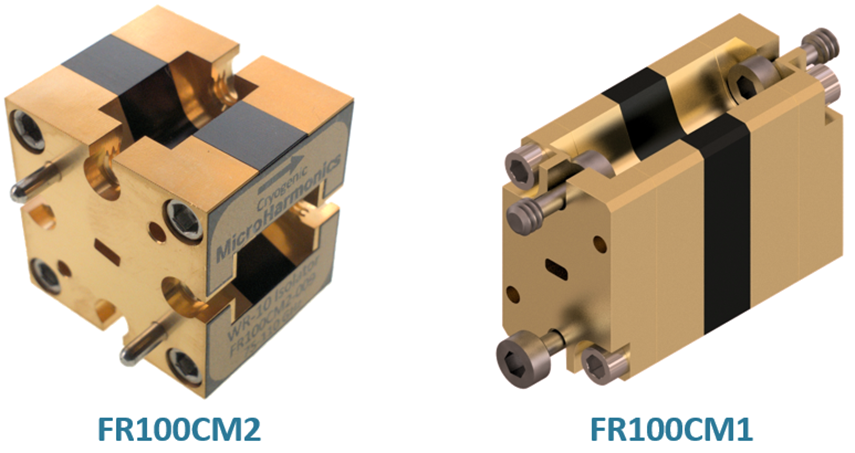
The result was an extremely compact variant of our cryogenic WR-10 isolator (model FR100CM1). It highlights a recurring theme in mm-wave hardware: small changes in mechanical layout can unlock major architectural possibilities when integrating multiple channels into a cryogenic instrument.
Non-Standard Bands for THz Multiplier Chains
Once systems cross into the THz frontier, frequency multipliers become the backbone of signal generation. However, they are notoriously sensitive to reflections. Even a small mismatch between stages can disrupt multiplier efficiency or introduce unwanted ripple.
Several customers approached us with a common problem: their multiplier chains operated in bands that didn’t exist in the standard waveguide catalog. For example:
| Output Band | Frequency (GHz) | Frequency Multipliers | Input (GHz) |
|---|---|---|---|
| WR-2.2 | 330–500 | ×2×2 = ×4 | 82–125 |
| WR-1.5 | 500–750 | ×2×3 = ×6 | 83–125 |
| WR-1.0 | 750–1100 | ×3×3 = ×9 | 83–122 |
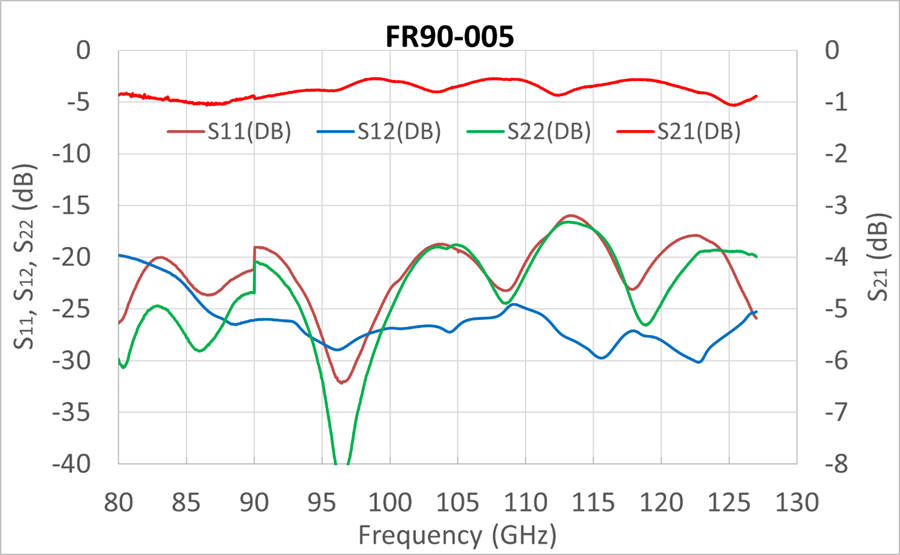
These architectures all point back to roughly the same input range, but none of them lined up neatly with standard isolator offerings. To stabilize these chains, we designed a custom WR-9 isolator covering the 82–125 GHz frequency range. Testing spanned both WR-10 and WR-8 fixtures, which produced a slight artifact near 90 GHz, but the overall performance confirmed the value of building an isolator specifically for that band.
A cryogenic version followed, and today it’s part of sensitive radio-astronomy systems studying extreme astrophysical environments such as black holes. These are use cases where every decibel of performance counts and where access to the “in-between” waveguide bands can determine whether a system hits its performance marks.
Extending Circulator Technology into the Cryogenic W-Band
As quantum computing experiments push deeper into microwave and mm-wave frequencies, researchers need components that behave reliably at cryogenic temperatures. One group working in W-band (85–104 GHz) needed a circulator that could operate near 25 K.
We already had a patented hybrid circulator for that band, but cryogenic operation introduces a different set of thermal, material, and magnetic-bias considerations. By leveraging what we learned from developing cryogenic isolators, we adapted the existing design and validated its performance quickly, confirming operation down to 25 K in just a few weeks.
That effort produced the first cryogenic W-band circulator of its kind (model HC100C). More importantly, it demonstrated how design experience at room temperature doesn’t automatically extend into cryogenic regimes; the transition requires focused engineering, empirical testing, and iteration.
What These Projects Have in Common
Each example above began with a researcher asking a simple question: Is this possible? The answers required mechanical redesigns, band-specific ferrite work, new test setups, and sometimes pushing technologies into temperature ranges they had never seen before.
Across radio astronomy, quantum research, and THz systems, the broader trend is the same. As instruments become more ambitious and frequency requirements expand, component design has to evolve alongside them. Whether it’s a narrower flange, a custom band, or operation at 25 K, the smallest details often determine whether an experiment reaches the performance level the science demands.
Micro Harmonics’ role in this ecosystem is straightforward: listen carefully, study the constraints, and engineer solutions that enable the next round of discovery. Whether it’s isolators, wide-band circulators, variable attenuators, or orthomode transducers, our products are designed to meet the demands of advanced mm-wave and terahertz applications. The work above reflects our ongoing commitment and shows how much untapped potential still exists when the right challenges meet the right engineering approach.
If you’re exploring a new project or need a custom solution, contact us to discuss your requirements.